





Not every warning light can wait. Learn which dashboard warning lights mean stop immediately and what to do before serious damage occurs.
That moment when a light flickers on your dashboard mid-journey is something most drivers dread. Your heart sinks, your mind races, and suddenly you are wondering whether to pull over or carry on to your destination. The truth is, not all warning lights carry the same urgency. Some are gentle reminders. Others are telling you to stop the car right now.
Knowing the difference is not just useful knowledge. It could be the thing that saves your engine, your safety, and a very expensive repair bill. Whether you drive through Guildford or the surrounding areas, understanding your dashboard is as important as keeping on top of your car service and making sure your vehicle is ready for its MOT test. This guide will walk you through the warning lights that demand immediate action and explain exactly what to do when they appear.
The Colour Code Your Dashboard Uses
Before diving into individual lights, it helps to understand the system your car already uses to communicate with you. Dashboard warning lights follow a traffic light logic, and once you understand it, everything else makes far more sense.
- Red means danger. Stop the car safely as soon as it is possible to do so and do not continue driving.
- Amber or yellow means caution. Something needs attention soon, but it is not necessarily an emergency right now.
- Green or blue means informational. A system is active and working as it should.
The lights that this article focuses on are the red ones, and a few flashing amber ones, because these are the signals your car uses when something critical is wrong. A red warning light means there may be a serious fault with a vehicle, and drivers should not begin a journey with a red warning light showing. If one appears while driving, it is advised not to stop in a live lane unless absolutely necessary.
5 Warning Lights That Mean Pull Over Immediately
Not every red light carries identical severity, but the following five are the ones no driver should ignore, even for a few more miles.
1. Oil Pressure Warning Light
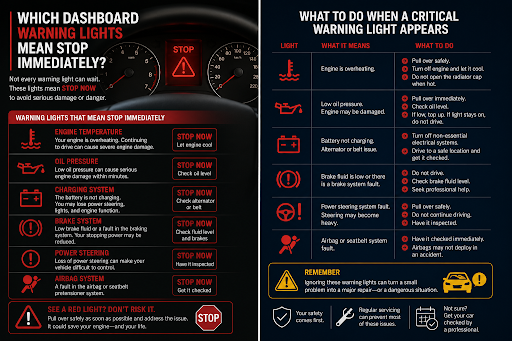
This is arguably the most urgent light on your entire dashboard. It looks like an old-fashioned oil can and it usually appears in red. When it comes on, it does not mean your oil is slightly low. It means there is insufficient oil pressure circulating through the engine at that moment.
Oil is not circulating at sufficient pressure and engine components are being damaged right now without lubrication. It is described as the most critical warning light on a dashboard, and the advice is to pull over safely, switch off the engine immediately, not restart it, and call for recovery.
Running your engine for even a few minutes without proper oil pressure can cause permanent, irreversible damage to internal components. Do not top up the oil and drive on in hope. Stop, call for assistance, and let a qualified technician diagnose the cause before the engine is restarted.
2. Engine Coolant Temperature Warning
This light, often shaped like a thermometer sitting in liquid, appears when your engine is running dangerously hot. Overheating is one of the most destructive things that can happen to a modern engine, and it can escalate from bad to catastrophic within a very short distance.
The causes can include low coolant, a failed thermostat, water pump failure, or a blown head gasket, and continued driving causes severe engine damage within minutes. The recommended action is to stop safely, switch off the engine, and allow it to cool for at least 30 minutes before checking coolant, and never to remove the cap while the engine is hot.
If you notice the temperature gauge creeping into the red zone, or if this warning light appears, find a safe place to stop as soon as traffic and road conditions allow. Turn the engine off, do not open the bonnet immediately, and wait. Attempting to push on is one of the most common causes of complete engine failure that drivers bring into garages.
3. Oil Level Warning Light
This one is often confused with the oil pressure light, but they communicate two different problems. The oil level warning typically appears in amber and indicates your oil has dropped below the safe minimum. It is less immediately catastrophic than the pressure light, but it should not be dismissed.
Unlike the red oil pressure light, the oil level warning means there is still oil present but not enough for sustained driving. The advice is to check the dipstick, top up with the correct grade of oil, and investigate the reason for the oil loss.
If you notice this light and you are away from home, pull over when it is safe, check your dipstick, and top up with the right oil specification for your vehicle. If the level keeps dropping regularly, there is likely a leak or internal consumption issue that needs a professional eye. You can read more about the kinds of signs your car gives you when it is not happy in our guide onwarning signs you should not ignore.
4. Brake System Warning Light
The brake warning light is one that causes real anxiety, and rightly so. Most drivers are familiar with this light appearing when the handbrake is on. But if it comes on while you are driving with the handbrake fully released, that is a different situation entirely.
There are many reasons this light can appear, and if the ABS warning light is also illuminated alongside the brake warning, it could mean there is something seriously wrong with the braking system.
Brakes are not a system you can compromise on, even briefly. If this light appears during a journey and you have not applied the handbrake, slow down gradually and find somewhere safe to stop. Do not continue driving and do not attempt to brake heavily if you can avoid it. Have the car recovered or inspected before getting back on the road. Dashboard warning lights use a colour system similar to traffic lights, and they are designed to warn when there may be an issue with the vehicle, meaning drivers should respond appropriately and safely.
5. Battery and Charging System Warning Light
This light looks like a battery and usually appears in red. When it comes on, it does not always mean the battery itself has failed. More often, it signals that the alternator, the component responsible for keeping the battery charged while you drive, is not functioning correctly.
If this light does not go out a few seconds after starting the engine, there could be a fault in the alternator, battery, or electrical system, meaning the car is not charging itself when driving and this could cause the battery to run down and the engine to eventually stop.
If this light appears mid-journey, the practical advice is to turn off anything that draws unnecessary power such as air conditioning, heated seats, the radio, and phone chargers. This buys you a little more distance, but it is not a permanent solution. Battery warning lights show charging system problems, and the advice is to switch off non-essential electrical loads like air conditioning, heated seats, and stereo systems. Get the car to a garage as quickly as you safely can rather than attempting a longer journey.
Flashing Lights Versus Steady Lights
There is an important distinction that many drivers overlook. A steady warning light and a flashing warning light do not mean the same thing. Flashing is always more urgent.
Flashing lights typically indicate more urgent situations than steady lights. For example, a flashing engine management light suggests misfiring that could damage the catalytic converter, while steady lights indicate detected faults that need attention. Flashing red lights usually require immediate stopping, while flashing amber lights need urgent but not necessarily immediate attention.
If any light on your dashboard is flashing red, treat it as a stop now situation. Find a safe place off the road, switch the engine off, and seek professional help before continuing.
What to Do the Moment a Red Light Appears
Seeing a red light appear when you are on a busy road or motorway can be stressful. Having a clear plan in your head before it happens makes all the difference.
- Stay calm and do not brake suddenly.
- Indicate and move to the left lane gradually.
- Find a safe place to stop such as a layby, car park, or side road.
- Switch off the engine once you are safely stopped.
- Turn on your hazard lights to alert other drivers.
- Do not attempt to restart the engine until you know what is wrong.
- Contact a professional garage or recovery service for advice.
The worst thing a driver can do is ignore a red warning light and carry on, hoping it clears itself. In a small number of cases, lights do reset after a temporary sensor issue. But in the majority of cases, carrying on means making the underlying problem significantly worse.
Amber Lights You Should Not Leave for Long
While amber lights do not demand you pull over immediately, several of them become serious problems very quickly if they are ignored for days or weeks.
Engine Management Light (EML): This light can mean anything from a loose fuel cap to a failing catalytic converter. A steady EML allows you to continue driving cautiously, but a flashing EML means stop immediately. Either way, the car needs a diagnostic check promptly. A vehicle with an illuminated EML will also fail its MOT.
Tyre Pressure Warning: Low tyre pressure increases stopping distances, affects handling, and can lead to a blowout at speed. Check all four tyres when the vehicle is cold and inflate to the recommended level shown in your door frame or handbook.
Power Steering Warning: If this light appears, you may notice the steering feels unusually heavy. If the power steering warning light comes on, it is not advisable to drive a vehicle with the red power steering warning light on, as if the power steering system fails the car becomes harder to manoeuvre and could be dangerous to drive.
DPF Warning (Diesel vehicles only): The diesel particulate filter warning indicates a blocked exhaust filter. This can often be resolved by a longer motorway drive to burn off the soot, but persistent illumination needs garage attention.
If you have noticed any unusual noises alongside a warning light, it is worth reading our guide on strange car noises and what they mean, as the two often point to the same underlying issue.
Does a Warning Light Cause an MOT Failure?
Yes. Several warning lights will result in an automatic MOT failure if they are illuminated during the test. The engine management light is the most well-known example, but brake system warnings and airbag lights also fall into this category.
If you are based in Guildford and due for an MOT, it is always worth having any active warning lights diagnosed and resolved before booking your test. Bringing a car in with an unresolved red or amber light is a near-certain way to walk away with a failure certificate.
According to GOV.UK guidance on vehicle roadworthiness, vehicles must meet specific safety standards to pass an MOT, and warning lights related to safety-critical systems are part of that assessment.
A Common Misconception Worth Addressing
Many drivers assume that if the car still drives normally after a warning light appears, nothing serious can be wrong. This is one of the more dangerous assumptions in motoring.
Some of the most destructive engine and mechanical failures develop silently in the early stages. The oil pressure light can come on briefly before the engine has already begun to suffer internal wear. The coolant temperature warning can appear with just a few minutes of driving left before serious damage sets in. The fact that the car feels fine to drive is not a reliable indicator of safety when a red light is showing.
Trust the lights. They are the only voice your car has.
Conclusion
Your dashboard is not trying to alarm you unnecessarily. Every warning light that appears is your car communicating something specific, and the red ones are asking you to listen right now rather than later.
The oil pressure light, coolant temperature light, brake warning light, battery light, and flashing engine management light are all situations where pulling over promptly is the safest and most cost-effective response. Amber lights deserve attention within days, not weeks. And if you are ever unsure what a light means, your vehicle handbook is the most reliable first reference, followed by a call to a trusted local garage.
Drivers in Guildford and the surrounding areas who want their vehicle checked after a warning light has appeared are encouraged to book a professional inspection before the issue develops into something more serious.
Frequently Asked Questions
Can I drive with a red warning light on? In most cases, no. Red warning lights indicate a serious or safety-critical fault. The safest action is to pull over when it is safe to do so and seek professional advice before continuing your journey.
What does a flashing engine management light mean? A flashing engine management light typically indicates an active engine misfire that could damage the catalytic converter. Unlike a steady light, a flashing EML requires you to stop driving as soon as it is safe and get the vehicle checked immediately.
Will a warning light make my car fail its MOT? Yes. Warning lights related to safety-critical systems such as the engine management system, brakes, and airbags are grounds for an MOT failure. Have any active lights investigated and resolved before your test.
Why did my warning light come on and then go off? A light that briefly illuminates and then clears could be a temporary sensor fault or a minor issue that resolved itself. However, it should still be investigated with a diagnostic check, as intermittent faults often become persistent ones.
Is the oil pressure light the same as the oil level light? No. The oil pressure light is a red warning indicating inadequate oil pressure circulating through the engine right now, which is an emergency. The oil level light, often amber, means the oil quantity has dropped below the recommended minimum, which is serious but slightly less immediately critical.
What should I do if multiple warning lights come on at once? If several warning lights appear simultaneously, stop driving as soon as it is safe and contact a professional. Multiple lights activating together often indicates a more complex underlying fault that requires immediate attention.