




In recent years, the demand for high-quality charcoal has grown significantly due to its diverse applications in energy production, agriculture, and industrial processes. To meet this growing demand efficiently and sustainably, manufacturers are turning to advanced technologies like the continuous carbonization furnace. This equipment plays a central role in the operations of a charcoal production plant, helping to streamline the carbonization process, increase output, and reduce environmental impact.
Understanding Charcoal Production Technology
Charcoal is produced through the carbonization of biomass — the process of heating organic materials such as wood, coconut shells, rice husks, bamboo, or sawdust in a low-oxygen environment. Traditionally, this process was performed using simple earth kilns or batch-type furnaces, which required long cycles, consumed large amounts of energy, and produced significant emissions.
However, with technological advancement, modern charcoal production plants have shifted towards automated and continuous systems. These plants now integrate advanced machinery that enables steady feeding, efficient heating, and controlled carbonization. Among these innovations, the continuous carbonization furnace stands out as one of the most critical components.
What is a Continuous Carbonization Furnace?
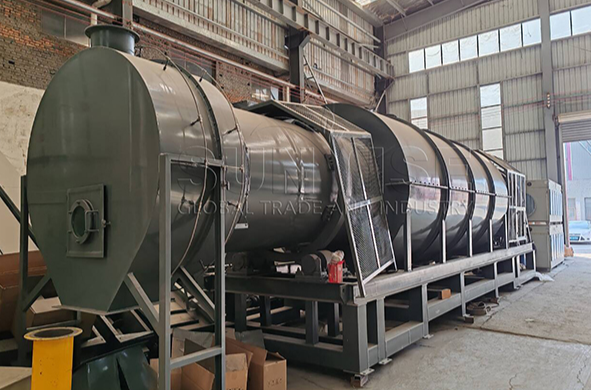
A continuous carbonization furnace is an advanced type of charcoal-making equipment designed to operate nonstop. Unlike traditional batch furnaces that require loading and unloading between each cycle, this furnace continuously feeds raw materials into one end while charcoal is discharged from the other.
Inside the furnace, the biomass undergoes a thermal decomposition process at temperatures typically ranging between 300°C and 600°C. The material is first dried, then pyrolyzed under limited oxygen conditions to produce charcoal, combustible gases, and bio-oil byproducts. The continuous operation ensures stable temperature control, consistent product quality, and higher production efficiency.
Most continuous furnaces include several integrated systems:
- Feeding and drying units: Ensure that biomass with moisture below 15% enters the furnace for efficient carbonization.
- Carbonization chamber: Rotating or fixed design that ensures uniform heating and complete carbonization.
- Cooling section: Prevents charcoal from burning when exposed to air during discharge.
- Gas recycling system: Collects combustible gases generated during pyrolysis for reuse as heating fuel, improving energy efficiency and reducing emissions.
The Advantages of Using a Continuous Carbonization Furnace
1. High Efficiency and Productivity
Because of its continuous operation, this furnace can process large volumes of biomass — up to several tons per day — without frequent downtime. For industrial-scale charcoal production plant, this translates into higher throughput, faster turnaround, and reduced labor costs.
2. Stable Charcoal Quality
The furnace maintains consistent temperature and residence time for all feed materials, ensuring that each batch of charcoal has uniform carbon content, density, and calorific value. This stability is crucial for businesses that sell charcoal for BBQ, industrial fuel, or activated carbon production.
3. Energy Savings and Eco-Friendly Operation
The continuous carbonization furnace is engineered for energy efficiency. It often features heat recovery and gas recycling systems that reuse combustible gases generated during pyrolysis. This not only lowers fuel consumption but also minimizes smoke and harmful emissions, making it an environmentally friendly solution.
4. Automation and Easy Control
Modern furnaces are equipped with intelligent control systems that monitor temperature, feeding rate, and exhaust flow. Operators can adjust parameters easily, reducing manual intervention and operational errors.
5. Versatility with Raw Materials
This furnace can process a variety of biomass types — from wood chips and coconut shells to rice husks, palm shells, and bamboo. Such flexibility makes it ideal for countries with abundant agricultural and forestry waste resources.
Integration of the Furnace in a Charcoal Production Plant
A charcoal production plant typically includes several interconnected systems to transform raw biomass into finished charcoal products. The continuous carbonization furnace serves as the core unit, supported by auxiliary machinery to handle pre-treatment and post-processing.
A typical production line consists of:
- Crusher: Reduces biomass size to less than 2 cm for uniform carbonization.
- Dryer: Removes moisture to improve carbonization efficiency.
- Continuous carbonization furnace: Performs the main pyrolysis process.
- Cooling and discharge system: Prevents re-oxidation of hot charcoal.
- Briquette machine (optional): Compresses powdered charcoal into uniform briquettes for packaging and sale.
- Dust and gas treatment unit: Ensures environmental compliance by filtering emissions.
When integrated properly, these components form a closed-loop system that maximizes energy recovery and minimizes waste.
Environmental and Economic Benefits
The shift toward continuous carbonization technology aligns with global trends in sustainable manufacturing. Traditional kilns often release unburned gases, smoke, and volatile organic compounds, contributing to air pollution. In contrast, a modern charcoal production plant equipped with a continuous furnace captures and recycles byproduct gases. This reduces greenhouse emissions and improves overall energy utilization.
Economically, the improved efficiency and automation reduce labor and fuel costs, resulting in a lower cost per ton of charcoal. For regions with abundant agricultural residues — such as coconut shells in Southeast Asia or rice husks in Pakistan — this system offers an effective way to convert waste into valuable, eco-friendly energy products.
Choosing the Right Equipment
When selecting a continuous carbonization furnace for your production line, consider the following:
- Capacity requirements: Match the furnace’s output with your expected raw material supply and market demand.
- Raw material type: Choose a model optimized for your primary biomass feedstock.
- Energy source: Ensure compatibility with your preferred heating fuel — natural gas, biomass gas, or electricity.
- Automation level: Higher automation reduces labor but may increase initial investment.
- After-sales support: Reliable maintenance, spare parts, and technical service are essential for long-term operations.
Working with experienced manufacturers like YSXCharPro can ensure access to durable, energy-efficient equipment that meets international standards.
The Future of Charcoal Manufacturing
As sustainability becomes a global priority, the role of innovative equipment such as the continuous carbonization furnace will continue to grow. Future charcoal production plants are expected to integrate smarter monitoring systems, AI-driven process control, and enhanced gas recovery to achieve net-zero emissions.
By investing in advanced technology today, manufacturers can not only improve their production capacity and product quality but also contribute to a greener and more sustainable future.
Conclusion
The continuous carbonization furnace represents a major leap forward in modern charcoal manufacturing. Its continuous operation, high efficiency, and eco-friendly performance make it an indispensable component of any advanced charcoal production plant. Whether you are upgrading an existing facility or starting a new operation, adopting this technology ensures higher productivity, reduced costs, and a cleaner production process — the key to long-term success in the global biochar and charcoal market.