



Introduction
With the fierce competition in the automotive industry, especially in the new energy vehicle market, car makers have to deal with the challenges of developing lightweight and highly complicated parts that can improve vehicle range and performance but at the same time keep costs low and fasten product launch time. Conventional multi-process and multi-setup processes are not only inefficient but also prone to error accumulation leading to part rejection and causing great loss of money and time.
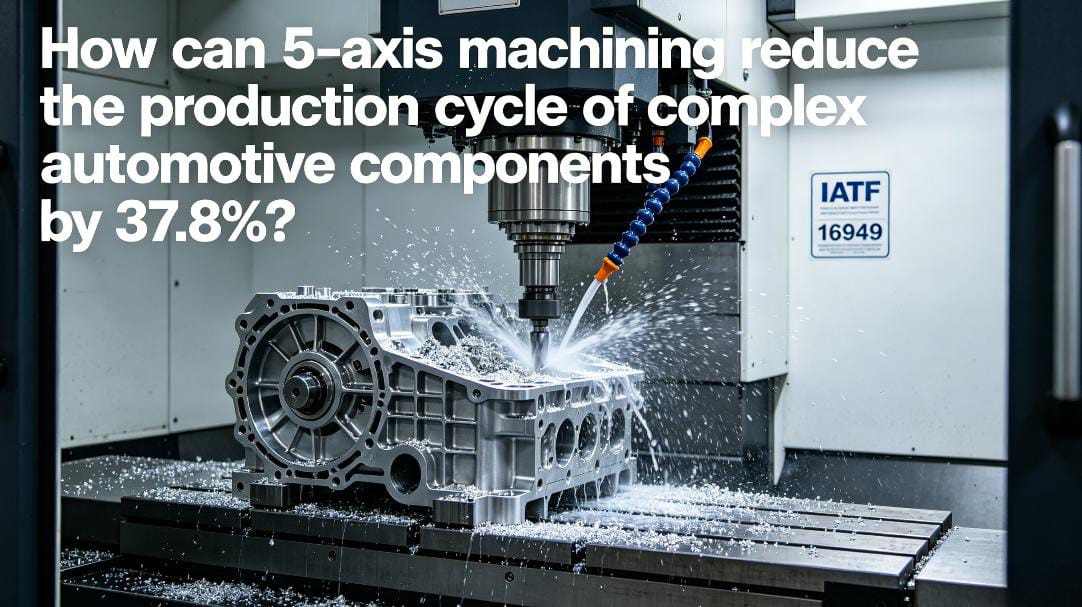
The reason behind the issue is the inherent limitation of conventional 3-axis machining process in today’s highly integrated products. The current paper will discuss a high-level manufacturing technology based on the idea of Smart Factory, which is 5-axis CNC machining, and demonstrate how it solves these problems with the example of achieving 37.8% decrease of cycle time for complex gearbox housing parts.
Why Is 5-Axis Machining Important for the Success of High-Efficiency Automotive Production?
Modern automotive products such as integral die cast chassis and complicated motor housings pose a challenge to traditional 3-axis machining methods. The problem with multi-setup, accumulated errors, and long production lead-time becomes an inherent problem that goes against the requirement for fast and accurate automotive manufacturing.
- Inefficiencies of Traditional 3-Axis Methods: The traditional approach of 3-axis machining requires several setups to machine a single complicated component. Each time the position changes, there will be datum shift error and deformity from clamping. For a gearbox housing where features are located at all six sides, the accumulated error from five or more setups will add up to ±0.1mm. This error will go beyond the tolerance of critical sealing surfaces.
- The Single Setup Concept of 5-Axis Machining: The 5-axis CNC machining technology consists of adding 2 rotational axes (A/C or B/C) to traditional linear movements, making it possible for the tool to reach the object from any direction. Thus, all elements of the work piece including complex curved surfaces, deep cavities, and multi-angle parts can be processed in a single clamping position. There are three significant advantages that follow: avoidance of positioning mistakes, reduction of handling, and combination of several operations into one continuous procedure. All of those are in accordance with Smart Factory concept.
- Effect on Production Cycle Time: A real-life production scenario with a project for a gearbox housing shows the effect. In the initial process using the 3-axis process, 7 operations and 74 minutes of total cycle time were needed. In the subsequent process that used the 5-axis machining and the optimized toolpath and fixture setup in a single operation, only 2 operations and 46 minutes of total cycle time were needed.
What Is the Strategy for Achieving Micron Level Accuracy in 5-Axis Machining of Complex Parts?
To ensure consistent micron level accuracy in 5-axis machining of complex parts, a methodological way involving machine calibration, environmental control and compensating mechanisms needs to be adopted. These methodologies convert 5-axis machining into consistent accuracy.
1. Systematic Machine Calibration and Compensations
Accuracy of 5-axis machines is compromised gradually due to wear and thermal factors. Laser interferometer and ballbar test measures positioning error in all the five axis. This information is then utilized to generate compensations tables for volumetric errors within its operational range. For instance, in a 5-axis machine whose rotating table is 1.5 meter in diameter, volumetric calibration by laser tracker decreases positional errors from ±0.02 mm to ±0.005mm.
2. Thermal Stability by Environmental Control
Thermal distortion is one of the main reasons for dimensional drift in precision machining. During precision automotive machining, all finishing processes are carried out in an environmentally controlled setting at a temperature of 20°C ± 1°C. After roughing, thermal stabilization helps to balance the component before final finishing. This method will ensure the achievement of cylindricity tolerance of less than 0.008mm for bearing bores.
3. In-process Closed-loop Measurement
The modern 5-axis machine center comes equipped with on-machine probing systems (Renishaw probes) that measure important dimensions either during or just after the machining process. The measurements are relayed back to the CNC unit where compensation for wear, thermal effects, or bending is done. The closed-loop system keeps the tolerance at ±0.01mm through long production runs. This is very critical in a precision automotive components manufacturing firm.
How Are the Manufacturing Issues of EV Battery Tray and Motor Housing Overcome?
Big aluminum battery trays and deep motor housing are some of the most challenging products for manufacturing in EV components. They require special engineering techniques to address the problems of distortion, accessibility of tools and chip removal.
1. Control of Flatness and Distortion of a Big Battery Tray
A big battery tray machined from 6000 aluminum alloy and having dimensions 2000x1500mm has to have the surface flatness ≤0.1mm. Here we face the problem of controlling distortion due to heating and clamping. The solution includes the use of special fixture for clamping with equal force distribution along the part contour and a special process consisting of roughing, thermal equalizing hold, and finishing with light depth of cut.
2. Deep Cavity Motor Housing Milling
Deep cavity motor housing with a depth-to-diameter ratio of 5:1 is extremely challenging due to excessive deflection of tools and chip ejection. The technique involves milling toolpaths in such a way as to ensure favorable engagement angles and therefore low cutting forces and no vibrations. Dedicated long reach tools with internal cooling channels supply the cutting zone with high-pressure coolant to remove chips from the cutting zone.
3. Integrated Process Validation
These processes have been validated through extensive tests. In the case of battery tray, 100% of the sealing surfaces have been tested using CMMs and there are no leaks hence no defects. In the case of motor housing, the bore cylindricity and surface finish have been verified based on the specifications. This results in a manufacturing process that produces lightweight automotive parts with the required strength and functionality. A thorough technical discussion of these processes can be seen in a case study of 5-axis machining automotive components.
How does the Smart Factory Enhance 5-Axis Machining Production?
The smart factory approach goes beyond machine capabilities to incorporate simulation, data acquisition, and analysis. This digital solution turns 5-axis machining production into a smart and intelligent one.

1. Simulation to Avoid Collisions and Optimize Toolpaths
Prior to cutting of metal parts, a virtual model of the machine, fixture, and workpiece is created using the VERICUT software or equivalent software. The complete CNC program is then simulated for detection of any possible collision involving the tool holder, spindle, and workpiece. The toolpath strategies are optimized beforehand without having to test the machine.
2. Predictive Maintenance Using IoT
IoT sensors on the machine provide data related to spindle loads, vibration signatures, and temperature in real-time. The machine learning models use these parameters to analyze the patterns related to wear of the tools. When the vibration parameter crosses the defined limit, the remaining tool life is predicted with more than 85% accuracy and scheduling of a preventative tool replacement in planned down-time is done. With this predictive maintenance solution, there will not be any unexpected breakdown and efficient utilization of machine is achieved.
3. Optimization of OEE Through Data Analysis
Data about running time, cycle time, and the reasons for downtime is collected from the machine and entered into the Manufacturing Execution System (MES) . Analytics provides information about the root cause of inefficiencies like setup time and micro-stoppages. Necessary measures are taken to optimize the OEE to 85% and beyond. This is the crux of advanced automotive manufacturing.
What are the Important Certifications and Capabilities That Your Potential Partner Should Have?
Choosing a reliable manufacturer is not only about their technology; you need to consider their quality management, certifications, engineering skills. Those things will tell you whether your potential business partner is capable of providing you with the required level of precision and reliability.
- Relevance of Industry-specific Certifications: Quality certifications offer independent validation of the process maturity of the supplier. IATF 16949 certification is compulsory for automotive suppliers and requires APQP , FMEA and PPAP. AS9100D (aerospace) and ISO 9001 certifications add further confidence about the quality management system. Precision parts supplier for the automotive industry certified by these standards has shown its capability to adhere to high industry standards.
- Full Traceability and Documentation Capability: An effective supplier will ensure that all orders are documented in their entirety through First Article Inspection Report (FAIR) which includes all measurements taken on the important dimensions, Material Test Certificate (MTC) , and Statistical Process Control (SPC). The traceability system assigns an individual serial number to each component and includes all of its details, from batch material used to operator information.
- Collaboration in Engineering and DFM Skills: In addition to manufacturing capabilities, the right partner has strong engineering capabilities as well. The partner gives feedback on Design for Manufacturing (DFM) during the process of quoting, giving you insights on ways to streamline your designs in terms of cost, quality, or geometry. This is the sign of a good partner for custom 5-axis machining for automotive projects. In case you are looking for a capable partner for custom 5-axis machining for automotive projects, visiting the respective service page can be helpful.
Conclusion
Given the ongoing trend toward electric cars and the drive towards lighter vehicles in the automotive industry, 5-axis CNC machining has emerged as the main technology due to its unmatched ability to process complicated geometry in one operation. With the integration of this technology with the data-driven approach of the Smart Factory, not only will manufacturers be able to shorten production time and cut down on production costs but also guarantee consistent quality of the products.
FAQs
Q1: Is 5-axis machining applicable for all automotive parts?
A: No, 5-axis machining is not appropriate for all automotive parts. It is more cost-efficient for simple flat parts to use 3-axis machining. 5-axis machining is highly effective for components with complicated geometry, deep holes, and multi-angled parts such as turbine blades, engine blocks, and motors housing.
Q2: The initial investment for 5-axis machining is high. How do you justify the investment?
A: While the initial investment is high, when processing complex parts, 5-axis machining considerably lowers per part cost by reducing setups, auxiliary time, and yields. Comprehensive cost analysis should be conducted for particular components.
Q3: How do you maintain quality consistency for volume parts made with 5-axis machining?
A: It is about maintaining the manufacturing process itself. Using Statistical Process Control (SPC) along with the in-line measuring system for 100% inspection as well as environment controls and machine calibrations allows us to maintain the quality consistently during the mass production process.
Q4: What if the design is submitted by the customer in file format?
A: The customer can send the design in any 3D format, like STEP or IGES. The design will then be reviewed professionally using our design for manufacturing (DFM) services along with any recommendations for design optimization.
Q5: Other than the automotive industry, which industries does your 5-axis machining serve?
A: We serve various industries such as aerospace, medical devices, robotics, energy, and many others that require high precision. We have certifications like IATF 16949 (Automotive Industry) and AS9100D (Aerospace).
Author Bio
The author has been working as a senior manufacturing engineer in developing and optimizing 5-axis CNC machining processes for the past 15 years. He is specialized in offering customized manufacturing solutions to customers in the manufacturing of complex components in new energy vehicles and aerospace industry. LS Manufacturing offers state-of-the-art 5-axis machining capabilities with IATF 16949, AS9100D and ISO 9001 certification standards.