





Introduction
In medical device manufacturing, a microscopic injection molding defect can lead to life-threatening consequences or multimillion-dollar recall losses. Traditional quality control methods, such as relying on final inspection, often fall short when meeting the stringent precision and purity requirements of complex components, especially when using high-performance materials like PEEK and PC. Defects such as flash and weld lines cause project delays and audit failure
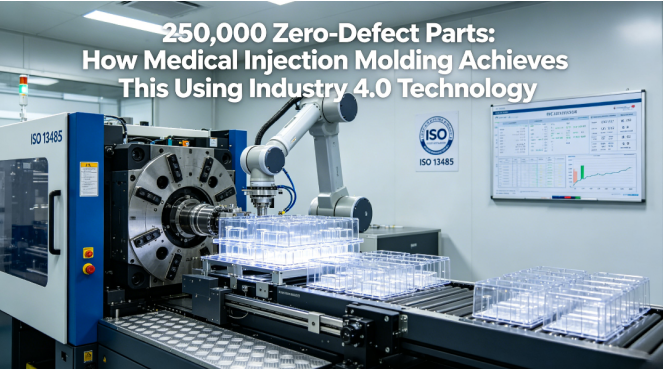
The arrival of Industry 4.0 offers a new paradigm for solving these persistent challenges. This article explores how integrating smart manufacturing principles with ISO 13485 certified precision medical injection molding services builds a predictable, traceable, zero-defect production system. By leveraging data-driven process control and closed-loop feedback, manufacturers can transform uncontrollable defects into engineered parameters, ensuring consistent quality across hundreds of thousands of parts.
Why Must Medical Injection Molding Transcend Traditional Quality Standards?
Medical devices demand a level of perfection that standard injection molding cannot guarantee. The stakes are too high for reliance on post-process inspection alone. A fundamental shift toward proactive, data-driven quality systems is essential.
l The Unique Demands of Medical Device Manufacturing: Medical components — implants, diagnostic cartridges, drug delivery systems — require zero defects, biocompatibility, and sterility. A single flash on a sealing land or a microscopic void in a thick section can render a device unsafe. Traditional injection molding suppliers, lacking medical manufacturing know-how, struggle with the tight tolerances demanded by materials like PEEK, PC, and PEI. They often produce deadly flaws such as weld lines and dimensional discrepancies that fail FDA audits. This gap makes selecting a specialized Medical Injection Molding Service a matter of patient safety, not just quality.
l The Limitations of End-of-Line Inspection: Relying on final inspection to catch defects is fundamentally reactive. By the time a non-conforming part is identified, the entire batch may be compromised. For Class II/III devices, the cost of scrap, rework, and delayed market entry far exceeds the investment in a robust process control system. Smart Manufacturing principles flip this paradigm: instead of inspecting quality into parts, quality is manufactured into every cycle through real-time monitoring and adaptive control.
l Industry 4.0 as the Solution Framework: Industry 4.0 technologies — IoT sensors, big data analytics, and closed-loop control systems — provide the toolkit for achieving zero-defect medical molding. By collecting and analyzing process data in real-time, manufacturers can predict and prevent defects before they occur. This data-driven approach is the foundation of a compliant ISO 13485 Injection Molding system, transforming regulatory compliance from a burden into a competitive advantage.
How Does Industry 4.0 Eliminate Catastrophic Injection Molding Defects?
Real-time process monitoring and closed-loop control are the weapons against defects. A case study of a critical ventilator valve demonstrates how Industry 4.0 principles transformed a 72% yield rate into 99.98% through scientific molding and data-driven intervention.
H3: 1. The Case of the Failing Ventilator Valve
A global respirator manufacturer faced an emergency. Their proprietary high-barrier check valve, molded from a medical-grade PC-PBT blend, exhibited significant flashing defects exceeding 0.08mm on the sealing lands. The root cause was insufficient mold rigidity and unreliable V-P switchover from the previous vendor. The result was a critical 72% yield on leak testing, halting production of life-saving ventilators. This crisis exemplified the need for advanced defect control injection molding.
2. The Scientific Molding Intervention
LS Manufacturing’s engineering team deployed a rapid-response solution. The tool was reinforced with H13 steel and a four-cavity hot runner system. The critical intervention, however, was applying a scientific injection molding approach. Using cavity pressure sensors, the exact fill point at 95% cavity volume was determined. Then, within 0.01 seconds, the system switched to packing pressure at 135 MPa. This precise, data-driven V-P switchover eliminated the over-packing that caused flashing.
3. The Measurable Outcome
The intervention proved transformative. Flash was completely eliminated, and part dimensions were consistently held within a 0.005mm tolerance. More importantly, the non-destructive leak test yield soared to 99.98% . This consistent supply of conforming parts enabled the customer to resume production without further delays, saving an estimated $150,000 in potential penalty fees. This case perfectly illustrates how precision medical molding service powered by Industry 4.0 turns uncontrollable defects into predictable, controllable engineering parameters.
How Is Full Traceability Ensured Under ISO 13485 Certification?
Traceability is the backbone of medical device compliance. Under ISO 13485, every step of the manufacturing process must be documented and linked to the final product, creating an unalterable chain of evidence from raw material to shipped part.
1. Building the Digital Chain of Evidence
The traceability chain begins at material receiving. Each resin lot is logged into the Manufacturing Execution System (MES) with its certificate of analysis. Throughout production, every molding cycle is recorded: melt temperature, injection pressure, cooling time, and cavity pressure curve. These parameters are linked to the specific parts produced in that cycle. After molding, each part’s inspection results — dimensional data, visual inspection, and functional testing — are appended to its digital record.
2. The MES as the Central Nervous System
The MES integrates all data streams into a single, immutable database. This enables instant retrieval of the complete production history for any serial number. If a field issue arises, the manufacturer can trace back to the exact material lot, machine, operator, and process settings used to produce the affected parts. This capability is the essence of ISO certified medical molding and is essential for satisfying FDA audit requirements.
3. Compliance as an Insurance Policy
This systematic traceability transforms compliance from a burdensome obligation into a valuable insurance policy. Instead of scrambling to reconstruct records during an audit, the manufacturer presents a complete, auditable dossier. This not only satisfies regulators but also minimizes inspection costs and accelerates product approvals. For clients, working with an ISO 13485 injection molding manufacturer provides peace of mind that every part is backed by an unbreakable chain of evidence, as detailed in this comprehensive medical molding compliance guide.
How Does Custom Medical Injection Molding Balance Speed and Stability?
Medical device developers face a constant tension: bringing products to market quickly while ensuring production stability for regulatory compliance. Industry 4.0 principles reconcile these opposing forces by introducing production-grade controls during the prototyping phase.
- The Serial Process Bottleneck: Traditional development follows a serial path: prototype with soft tooling, validate the design, then build production tooling. This sequential approach is slow and risky. Issues discovered during production tooling trials require expensive and time-consuming design iterations. The result is delayed market entry and increased development costs.
- Parallel Process Validation Through Smart Manufacturing: Smart manufacturing enables a parallel approach. Using mold flow analysisand scientific molding principles, the process window is defined before any steel is cut. Prototype tooling is designed with production-grade cooling and gating, allowing process parameters to be validated on the first trial. Family mold designsenable simultaneous validation of multiple components, compressing the timeline.
- Seamless Transition to Production: When the design is frozen and production tooling is ready, the process has already been proven. The validated parameters from prototyping transfer directly to the production press, eliminating the typical trial-and-error period. This ensures that custom medical injection moldingprojects can deliver clinical trial or commercial launch quantities with the same quality and consistency as mature production runs. This integration of speed and stability is a hallmark of smart manufacturingin medical molding.
What Cost Dimensions Should Be Considered When Selecting a Medical Molding Partner?
Evaluating a medical molding partner requires looking beyond unit price to the total cost of ownership. A comprehensive analysis reveals that the lowest initial quote often conceals the highest total cost when factoring in compliance, quality, and risk.
1. Deconstructing the True Cost of Medical Molding
The total cost comprises several layers: tooling investment, per-part price, compliance overhead (cleanroom operation, SPC data collection, validation documentation), and hidden quality costs (rework, scrap, audit failures, delayed market entry). A quote that appears 20% lower may actually be 30% more expensive when these hidden costs are accounted for.
2. The DFM Lever: Reducing Cost Before Production Begins
The most powerful cost-control tool is applied before any tooling is ordered. A thorough Design for Manufacturing (DFM) review identifies opportunities to simplify geometry, relax unnecessary tolerances, or select more cost-effective materials without compromising function. Professional custom injection molding services providers offer this analysis as a standard part of their quoting process, typically identifying savings of 20% or more before any commitment is made.
3. Transparent Pricing and Full-Value Service
A reliable partner provides a detailed quote that separates capital costs (tooling) from piece price and compliance-related expenses. This transparency enables informed decision-making. The partner also offers full process validation documentation (IQ/OQ/PQ), material certifications, and inspection reports as part of the package, not as add-ons. When evaluating a precision medical molding service, the question should not be “What is the unit price?” but “What is the total cost of getting a compliant, reliable part to market?”
Conclusion
In summary, facing the increasingly stringent standards of medical device manufacturing, relying solely on empirical methods can no longer meet the requirements of zero defects and high compliance. Only by deeply integrating the smart manufacturing principles of Industry 4.0, adopting scientific molding and full-process data traceability, can true certainty from design to delivery be achieved. This is not only a commitment to product quality but also a strategic investment in the long-term success of the enterprise.
FAQs
Q1: What is ISO 13485 injection molding?
A: ISO 13485 injection molding refers to production conducted under this quality management system standard for medical devices. It requires full traceability and strict control from raw material to finished product, ensuring safety and efficacy.
Q2: What are the most common defects in medical injection molding?
A: The most common defects include flash, weld lines, short shots, and dimensional deviations. These defects critically impair part function, especially on sealing surfaces or thin-walled structures, potentially causing leaks or strength insufficiency.
Q3: How is biocompatibility ensured for medical injection molded parts?
A: The key is selecting appropriate medical-grade resins (e.g., USP Class VI or ISO 10993 certified materials) and producing them in a controlled cleanroom environment. Processing temperature and time must also be strictly controlled to prevent material degradation.
Q4: How does Industry 4.0 improve injection molding quality?
A: Industry 4.0 uses IoT sensors and real-time data analysis to achieve closed-loop control of the injection molding process. It instantly monitors and adjusts critical parameters like pressure and temperature, predicting and preventing defects to ensure batch consistency.
Q5: What should be considered when selecting a medical injection molding supplier?
A: Beyond price, focus on whether they hold ISO 13485 certification, their cleanroom classification, defect control capabilities, and whether they provide a complete process validation documentation package. A supplier offering one-stop service from DFM to final inspection is advantageous.
Author Bio
The author is a senior engineer with over a decade of experience in precision manufacturing, specializing in injection molding solutions for high-complexity parts in the medical, automotive, and aerospace industries. He is dedicated to helping clients overcome the most stringent manufacturing challenges through technological innovation and process optimization. LS Manufacturing provides comprehensive medical injection molding services backed by ISO 13485 certification, scientific molding systems, and Class 8 cleanrooms, serving as a trusted partner for medical device innovators requiring zero-defect production.