


In the latter half of the 17th century, European aristocratic society was swept by a fervor for Eastern culture and the Chinoiserie style. Enthusiastic collectors eagerly awaited the arrival of Spanish galleons, merchant ships, and East Indiamen, laden with embroidered silk curtains, exquisite lacquer cabinets and screens, masterful gilt craftsmanship, and blue-and-white porcelain vases. Chinese-themed entertainments and balls became the height of fashion, with conical hats and Manchu-style beards briefly all the rage.
During this period, even the French king was influenced by the Orient, captivating audiences with his lavish attire resembling that of an Eastern nobleman. These examples reflect the European aristocracy’s fascination with Eastern culture, integrating its exotic charm into fashion and daily life to emphasize its allure.
The Chinoiserie Portrait of Ralph Bankes by Sir Peter Lely from National Trust,image courtesy of National Trust
Around 1660, Sir Peter Lely painted Ralph Bankes in an Eastern-inspired robe, reflecting the relaxed elegance and sophistication of Chinese Chinoiserie. The robe embodies Eastern aesthetics, while the painting’s Western use of light and shadow highlights Chinoiserie’s unique allure as a fusion of Eastern motifs and Western techniques.
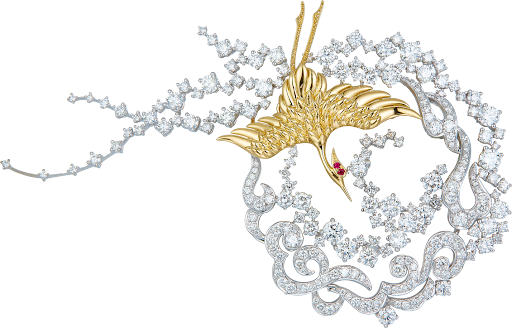
ChuCui Palace Crane Dancing in Clouds Brooch
ChuCui Palace, with its captivating blend of Chinoiserie aesthetics, often employs Western techniques of inlay, yet its themes and artistic expression reflect the essence of Eastern aesthetics. One of its works, the “Crane Dancing in Clouds” brooch, embodies the asymmetric composition characteristic of Chinoiserie, where the crane gracefully emerges from one side into the clouds, mimicking nature. Drawing inspiration from traditional Chinese auspicious cloud motifs, the piece also embodies the dynamic features inherent in Chinoiserie, derived from Rococo style, employing flowing curves to render the clustered clouds full and the flowing ones ethereal, with lines intersecting smoothly, exhibiting a natural rhythm and imbued with the distinctive sense of movement typical of Chinoiserie.
The piece emulates the subtle and elegant brushwork of Chinese ink painting, using only diamond white and gold hues, radiating brilliance and sophistication. Its charm lies not only in depicting the noble and graceful demeanor of the crane but also in creating timeless qualities, highlighting its “non-temporal” nature—it is vivid yet eternal, worldly yet transcendent. The jewelry embodies artistic expression, while the artistic expression carries poetic sentiment.
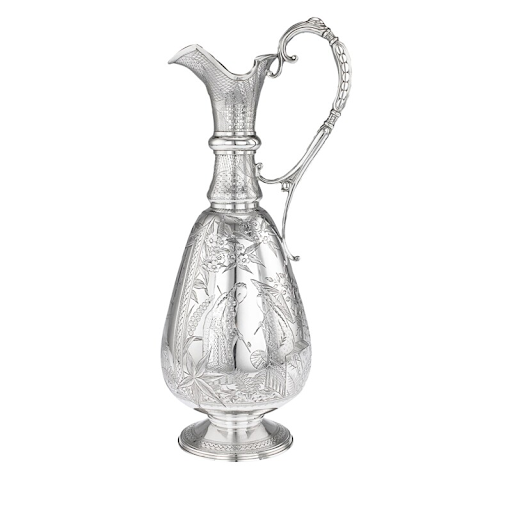

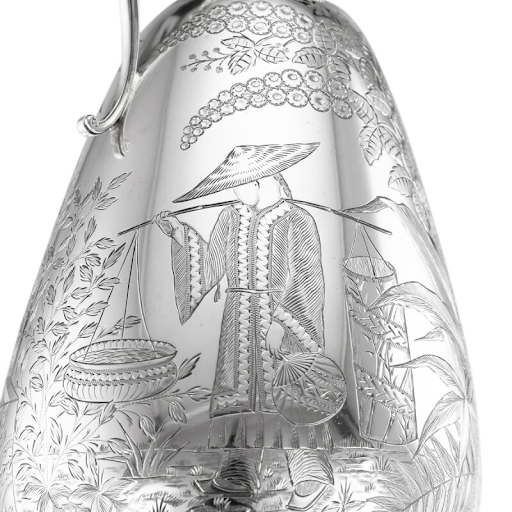
English-style Chinoiserie silver jug,image courtesy of Sotheby’s
In Chinoiserie-style works, English-style Chinoiserie silver jugs are particularly distinctive. As there were no Chinese precedents for such pieces, they were purely inspired by Chinese patterns and motifs and created by European craftsmen combining them with local European styles, making them more creative and appealing in their mixed form.
Among Sotheby’s auction items, there is a British-made English-style Chinoiserie silver jug manufactured by Richards & Charles Brown in 1879. The jug is carved with Chinoiserie-style scenes—people dressed in traditional Chinese attire, holding Chinese umbrellas, and a merchant carrying goods on his shoulder, surrounded by bamboo groves and garden landscapes. In the pattern design, we can see not only the beauty of “natural disorder” in Chinoiserie but also the characteristics of abstract textures in modern aesthetics. The work does not simply focus on the beauty of Rococo-style curves but combines straight lines with interwoven curves, geometric abstract textures, and narrative lines to create a rhythmic and delicate scene. This demonstrates how Chinoiserie, with the development of time, has also changed its aesthetic details and characteristics.
The charm of Chinoiserie lies in its unique fusion of Eastern and Western aesthetics. From the fervent pursuit of Eastern culture by European aristocratic society in the latter half of the 17th century to the precious collectibles of today, these works showcase the perfect blend of Eastern artistry and Western aesthetics. Both English silver teapots and the brooches from ChuCui Palace are masterpieces of Chinoiserie, presenting the harmonious coexistence of Eastern and Western cultures through exquisite craftsmanship and unique patterns. This allure not only resides in the aesthetic expression of the works themselves but also represents a respect for multiculturalism and a longing for exoticism. The tension and charm they emit are vivid manifestations of the fusion of Eastern and Western cultures, as well as the infinite possibilities of human artistic creativity.
References:
https://www.sothebys.com/en/buy/_antique-english-chinoiserie-silver-wine-jug-ad0e
https://www.nationaltrustcollections.org.uk/object/1257049