


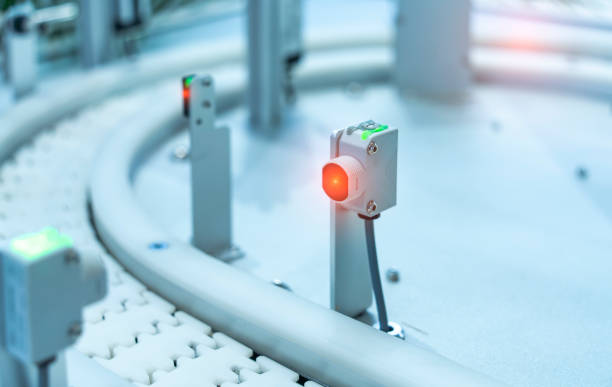
Measurement, non-contact or otherwise, is a vital aspect of productivity, safety, and overall efficiency in industrial automation. One of the most reliable solutions for these needs is a laser distance sensor. From manufacturing to logistics, these sensors are used in multiple industries because of the unmatched precision they have to offer.
Consider this article your guide to understanding how laser distance sensors function, their primary applications in industry, and the value they add to B2B businesses.
Laser Distance Sensor
As a subset of proximity sensors, laser distance sensors use a focused laser beam to measure an object’s distance. A laser pulse is emitted and the time it takes for the light to return is measured, allowing the sensor to precisely measure distance using time-of-flight (ToF) measurement. Even at long ranges, laser distance sensors are able to measure distance with millimeter precision.
Compared to traditional proximity sensors, most models of laser distance sensors are able to detect objects at a further range, often at or above 10m. In addition to that, the versatility offered by laser distance sensors for intricate industrial tasks is unmatched, as they are able to detect even very small, transparent objects.
If you’re looking for more in-depth information on proximity technologies, check out OMCH‘s guide for explanations related to sensor solutions.
Industrial Uses for Laser Distance Sensors
A variety of businesses with industrial laser requirements are starting to adopt laser distance sensors for tasks that have strict requirements for precision, speed, and longevity. B2B companies commonly use them for the following tasks:
Automated Warehouses and Logistics
Logistics laser distance sensors are mounted on Automated Guided Vehicles (AGVs), robotic forklifts, and stock control systems. They allow for stock level determination, navigation, object avoidance, and detection of fast moving objects.
Manufacturing and Process Control
For automation in the factory, laser sensors are crucial in the measuring, checking, and positioning of parts during their production. For example, these sensors are put on machines to measure metal sheets or ensure placement of components within the line is done correctly.
Packaging Industry
The packaging industry utilizes laser sensors to assist packaging machines ensure the products are properly aligned and positioned prior to sealing. Such sensors also verify dimensions of packaged items which helps minimize errors such as misplaced packaged goods or actual damages before shipment.### Safety Systems and Building Automation
Distance sensors for elevators, access control, or motion detection can all incorporate building automation systems using lasers. In safety related applications they supervise people or equipment within the area and may shut down machinery or set off alarms if required.
Agriculture and Mining Precision
Measuring the height of crops and aligning equipment for planting makes use of precision agriculture for laser sensors. They also monitor conveyor systems, devices which transfer material from one place to another and measure bulk materials in containers or silos during the mining process.
B2B Advantage Considerations
Business efficiency can be impacted greatly just by selecting the right sensor technology. Here’s why laser distance sensors are beneficial for B2B applications:
Range and Precision
Distance measuring lasers have the capability of taking accurate readings over great distances. In warehousing, machining, and automated inspection where measurements within a very small range are critical, this advantage is tremendously helpful.
Measurement Without Contact
Moving objects can be difficult to measure, and so are environments where contact is impossible. High temperatures and hazardous zones are examples of such places. Laser sensors are perfect for such scenarios, as they do not require contact.
Quick Speed Measurement Responding
The latest laser sensors provide quick measurement capabilities, enabling the tracking of fast-moving objects without delay. This benefit is ideal for high-speed production automation and robotics.
Easy Installation with Vertical and Horizontal Mounting
Laser sensors come in small sizes which can be easily integrated into tight or confined spaces. Compact modular designs allow for flexible mounting and positioning, even in retrofitting applications.
Dependable in Extreme Environments
Heavy industrial environments are often dusty, wet, or prone to vibration. A number of laser sensors will work in these environments thanks to rugged housings, IP rated protection, and reliable performance.
OMCH is a single source provider of laser distance sensors and proximity switches for many types of industrial applications. A wide range of sensor technologies for precision measurement can be found in their https://www.omchsmps.com/ru/path/proximity-switch/ .
Selection Criteria of a Laser Sensor
In terms of accuracy, range is often the primary feature looked at when choosing a laser distance sensor. B2B buyers and engineers have other important criteria such as:
Ranges of Measurements
Outline the distances which are the lower and upper limits intended to be measured. Each sensor is usually specifically designed; some are intended for short-range, high-precision tasks, while some are intended for long distances.
Reflectivity and Surface Targets
Factors such as surface color, material, and texture will influence the accuracy of the measurement. Surfaces that are matte or darker can lower the range and reflectivity of the sensor. Most industrial sensors are built to automatically adjust to these differences.
Condition Of The Environment
It is important to check if dust, water, vibration, or harsh chemicals may come into contact with the sensor. Select one with suitable protective coverings and environmental ratings such as IP65 or higher.
Connectivity And Output Type
Ensure that the sensor’s output (RS485, analog, digital, IO-Link, etc.) corresponds to your PLC or control system. AO-LINK equipped models are able to remotely monitor and provide diagnostics in real additional diagnostics.
Alignment And Mounting
Accuracy relies heavily on sensor alignment. Look for sensors with added laser pointer features as well as alignment aids. Other factors to consider include ease of mounting, installation space, flexible mounting options, and retrofitting.
Laser and OMCH Sensor
The change towards smarter systems is triggering a shift to real-time data analysis, cloud connectivity, and predictive analytics. Sensors with smart functions and reliable hardware are now being introduced by brands like OMCH, spearheading the transition.The selection of proximity switches manufactured by OMCH incorporate both general and specialized features. Whatever your business requirements may be pertaining to fast detection, high resolution measurements, or integration with control systems, OMCH provides B2B grade solutions engineered for contemporary industry needs.
Conclusion
The use of laser distance sensors in B2B non-contact measurement industries that necessitate speed, reliability, and precision is growing rapidly. They can be employed with automation systems for logistics, robotics, as well as precision manufacturing, showcasing their multipurpose capabilities.
With compact size, exceptional durability, and long-range detection capabilities, laser distance sensors heighten operational efficiency, safety, and strategic advantage among B2B companies.
The inclusion of advanced proximity technologies can be beneficial for your business, but partnerships with reputable suppliers like OMCH guarantee quality sensors and tailored assistance customized to your industrial requirements.