


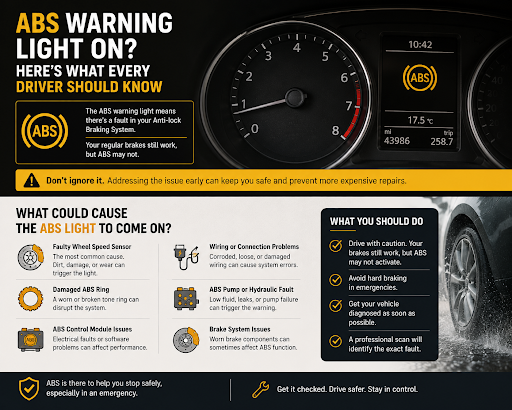
That amber ABS light on your dashboard is not something to ignore. Find out what it means, what causes it, and what to do next.
You are driving through Aldershot on a wet Tuesday morning, braking gently at a junction, when a small amber light catches your eye on the dashboard. It reads “ABS” and it has not gone out. Your first instinct might be to check whether your brakes feel normal, decide they do, and carry on. Most drivers do exactly that.
That is precisely the problem.
The ABS warning light is one of the most misunderstood dashboard indicators in any car. It is not telling you that your brakes have stopped working. But it is telling you something important: a critical layer of your vehicle’s safety system may no longer be there when you need it most. Understanding what that means, and what to do about it, is what this guide is for.
Whether your car has just flagged the light for the first time or it has been glowing away on your dashboard for a few days, read on. This is everything you need to know. Dashboard warning lights are one of the most common triggers for urgent garage visits, and the ABS light is no exception. If your car has been showing other unusual signals alongside it, it may also be worth reading up on what your car is trying to tell you before your appointment.
What Is the ABS Warning Light and What Does It Mean?
The ABS warning light appears as the letters “ABS” inside a circle, usually displayed in amber on your instrument cluster. In most cars, it flashes on briefly when you start the engine as part of the vehicle’s routine self-check, then disappears within a few seconds. That brief appearance is normal and expected.
When the light stays on after start-up, or comes on while you are driving, it is a different matter. It means the vehicle’s onboard diagnostics have detected a fault within the Anti-lock Braking System and the system has effectively shut itself down until the problem is resolved.
Crucially, this does not mean your standard brakes have failed. They should still function as normal under everyday driving conditions. What it does mean is that the ABS layer of protection, the system that takes over during emergency or hard braking, is no longer active. On a dry road in normal traffic, you may not notice the difference at all. On a wet Hampshire A-road when you have to brake sharply for a vehicle pulling out, that difference could matter enormously.
How ABS Actually Works (And Why It Matters)
To understand why the warning light is serious, it helps to understand what ABS does in practice. Anti-lock Braking Systems have been a legal requirement on all new cars registered in the UK since 2004, and for good reason. The system is built around one straightforward goal: keeping your wheels turning during hard braking so that you do not lose steering control.
Here is what happens when you brake hard without ABS. The wheels lock. Once locked, a tyre skids rather than rolls. A skidding tyre cannot generate meaningful steering input, which means the car goes where momentum takes it, not where you steer it. On a dry road, an experienced driver can manage this by pumping the brakes manually. On a wet or icy surface, the consequences can be severe.
ABS solves this by monitoring the rotational speed of each wheel using dedicated sensors. If the system detects that a wheel is decelerating too rapidly and is about to lock, it pulses the brake pressure at that wheel multiple times per second, far faster than any driver could manage manually. The result is that the wheels keep rolling, which means the tyres maintain grip, and crucially, you can still steer around an obstacle while braking hard.
The system also works alongside other safety features in modern vehicles. Traction control, electronic stability control, and in many cars automatic emergency braking all rely on the ABS infrastructure to function properly. When ABS develops a fault, those systems can be compromised too.
The Most Common Causes of the ABS Warning Light
The light can appear for a range of reasons, from something straightforward to something that genuinely needs professional attention. Here are the most common causes.
Faulty Wheel Speed Sensors
Each wheel on your car has its own speed sensor that feeds data to the ABS control module. These sensors sit close to the ground and are exposed to road debris, dirt, grit, and moisture on every journey. Over time, they can become dirty, corroded, or physically damaged. A sensor that is sending inaccurate data, or no data at all, will cause the ABS module to detect a fault and switch the system off. A faulty wheel speed sensor is the single most common cause of an illuminated ABS light.
Low Brake Fluid
The ABS hydraulic system relies on brake fluid to function. When fluid levels drop below the minimum, sensors can trigger the ABS warning light. Low brake fluid is often a symptom of a slow leak somewhere in the system rather than normal use, so it deserves proper investigation rather than simply topping up and hoping for the best.
ABS Control Module Failure
The control module is the brain of the system, processing data from all four wheel sensors and deciding when and how to modulate brake pressure. Like any electronic component, it can fail due to heat exposure, moisture ingress, or general wear over time. Module failures tend to require professional diagnostic equipment to identify and address correctly.
A Blown Fuse
The ABS system has its own dedicated fuse. A blown fuse will disable the system entirely and trigger the warning light. In isolation, this is a relatively minor fix. However, if the fuse blows repeatedly, it usually points to a deeper electrical fault in the system that needs tracing.
Damaged Wiring or Corroded Connections
Road salt, water, and general wear can damage the wiring harnesses connected to ABS sensors or the control module. Loose or corroded connections can cause intermittent faults, where the light comes on and off without a clear pattern.
ABS Pump or Hydraulic Unit Failure
The hydraulic pump regulates brake pressure when the ABS activates. If the pump is failing, the system cannot perform its core function and will shut down. This is typically a more complex repair.
| Cause | How Common | Typical Symptom |
| Faulty wheel speed sensor | Very common | ABS light on, may be intermittent |
| Low brake fluid | Common | ABS light, possibly brake warning light too |
| Blown fuse | Moderately common | ABS light on, sudden onset |
| ABS control module failure | Less common | ABS light on, other systems affected |
| Damaged wiring or connections | Moderately common | Intermittent ABS light |
| ABS pump failure | Less common | ABS light, unusual brake pedal feel |
Is It Safe to Drive with the ABS Warning Light On?
This is the question most drivers want answered straight away. The short answer is that your standard brakes will almost certainly still work with the ABS light on. In gentle, everyday driving conditions, you may not notice any difference at all.
However, driving with a known ABS fault does carry real risk. The moment you need to brake hard on a wet surface, on loose gravel on a country lane near Fleet, or in an unexpected emergency stop on the A331, the ABS is not there to help. Your wheels can lock, your steering becomes compromised, and your stopping distance on low-grip surfaces increases. For drivers who have grown up with ABS in every car they have ever driven, the instinct to push hard on the brake pedal in an emergency is well-established. Without ABS, that instinct can work against you.
There is also an important distinction to be aware of. If the ABS light appears on its own, you can drive with extra caution to a garage. If the ABS light appears alongside the red brake warning light, the situation is more urgent. Both lights illuminating together can indicate a serious fault with the braking system as a whole, not just the ABS layer. In that scenario, you should pull over safely, avoid driving the vehicle, and arrange for it to be inspected without delay.
Understanding your car’s warning lights is part of responsible ownership. If you are ever unsure what a dashboard light is communicating, a car service in Aldershot gives technicians the opportunity to run a full diagnostic check and give you a clear answer.
What the ABS Light Means for Your MOT
This is where drivers can get caught out, sometimes significantly. An ABS warning light that remains illuminated during an MOT is a major defect under current testing guidelines. According to the official MOT inspection manual published on GOV.UK, the anti-lock braking system is assessed as part of the brakes inspection, and a system fault is treated as a serious failure point.
In practical terms, this means your car will fail its MOT if the ABS light is on during the test. Given that ABS has been a legal requirement on new vehicles registered in the UK since 2004, any fault that prevents it from operating correctly is classified as a major defect. There is no grey area here.
The mistake some drivers make is assuming that because the car brakes normally, the ABS light will not affect the test outcome. That assumption is incorrect. The tester checks that the system self-clears at start-up and remains off throughout the inspection. A light that stays on is recorded as a failure regardless of how the brakes perform on the roller.
If your MOT is approaching and your ABS light is on, dealing with it before test day is the sensible move. Booking an MOT in Aldershot with a diagnostic check ahead of the test allows any ABS faults to be identified and resolved without the added pressure of a failed certificate.
What to Do When the ABS Light Comes On
The steps below give you a clear, practical framework for responding to an ABS warning light.
- Do not ignore it or cover it. The light is there to tell you something needs attention and that information is important.
- Check whether any other warning lights have appeared at the same time, particularly the red brake warning light. If both are on together, treat the situation as urgent and avoid driving the vehicle until it has been inspected.
- Check the brake fluid reservoir under the bonnet. The reservoir is usually a small translucent container marked with minimum and maximum lines. If the fluid is below the minimum, this could be contributing to the fault, but the underlying cause of the low fluid still needs to be investigated by a professional.
- Take note of when the light appears. Is it constant from start-up? Does it come on only at certain speeds or after a period of driving? Intermittent faults can be harder to diagnose, and any pattern you can describe to a technician is helpful.
- Drive with extra caution until the vehicle is checked. Increase your following distance, avoid heavy braking where possible, and be particularly careful on wet or slippery roads around Farnborough, Fleet, and the surrounding areas where road surfaces can vary.
- Book a diagnostic check promptly. ABS faults do not resolve themselves, and a sensor fault left unaddressed can sometimes lead to additional electrical or braking system issues over time.
The automotive industry has changed significantly over recent years, with modern diagnostic equipment now capable of pinpointing ABS faults with precision. A good local garage will connect your vehicle to a diagnostic tool, retrieve the fault codes stored in the ABS module, and identify whether the issue is a sensor, a fuse, the module itself, or something else entirely. You can read more about how the industry has evolved in this piece on how the UK auto repair industry has transformed over the last 15 years.
Can You Reset the ABS Light Without Fixing the Problem?
Some drivers discover that disconnecting the battery or using a basic OBD scanner can temporarily clear the ABS light. This is strongly inadvisable. The light will almost certainly return, because the fault has not been addressed. More importantly, clearing the warning without resolving the underlying issue leaves you driving without ABS and without the dashboard telling you so. You lose both the safety system and the warning that it is missing.
Professional diagnosis is the right approach. Once the fault is correctly identified and repaired, the light can be cleared properly using appropriate diagnostic equipment, and the system can be confirmed as fully operational before the vehicle leaves the workshop.
Keeping Your Braking System in Good Shape
ABS faults do not always come with obvious physical warning signs beforehand. However, there are habits and maintenance routines that reduce the likelihood of problems developing.
Regular servicing is the most effective line of defence. A thorough service includes checks of the brake system as a whole, including fluid condition and level, sensor connections, and any stored fault codes the vehicle’s onboard diagnostics may have logged. Catching an early sensor fault during a service prevents it from becoming a failed MOT or a more serious problem down the line.
Brake fluid should be changed periodically, as it absorbs moisture over time, which lowers its boiling point and can accelerate internal corrosion in braking components. Most manufacturers recommend a change every two years, though your vehicle handbook will confirm the specific interval for your car.
If you drive predominantly short distances around town, as many drivers in Aldershot and surrounding areas do, it is worth being aware that stop-start urban driving can be harder on braking components than longer motorway runs. More frequent brake applications mean more heat cycling, more wear, and potentially more debris accumulation around wheel sensors.
Conclusion
The ABS warning light is not a reason to panic, but it is absolutely a reason to act. Your standard brakes will likely still function, but the safety net that ABS provides in an emergency, on a wet road, in a sudden stop, at a junction that catches you off guard, is no longer there. That is a meaningful risk, not an abstract one.
The causes are often straightforward. A dirty sensor, a low fluid level, or a blown fuse can all trigger the light, and all can be resolved relatively quickly with the right diagnostic equipment. The key is not to delay, not to dismiss the light as something to deal with later, and not to assume that because the brakes feel normal, everything is fine.
Get it checked, get it resolved, and drive knowing your vehicle is working as it should.
Frequently Asked Questions
What does the ABS warning light look like? It typically appears as the letters “ABS” inside a circle, displayed in amber on your dashboard. Some vehicles also show a similar symbol with bracket-like shapes on either side. It illuminates briefly at start-up as part of the car’s self-check routine and should turn off within a few seconds. If it stays on, a fault has been detected.
Can I drive with the ABS warning light on? In most cases, your standard brakes will still work with the ABS light on, and you can drive carefully to a garage. However, you should avoid hard braking, increase your following distance, and be especially cautious on wet or slippery roads. If the ABS light appears alongside the red brake warning light, avoid driving the vehicle and arrange for it to be inspected immediately.
Will an ABS warning light fail an MOT? Yes. An ABS warning light that remains illuminated during an MOT is classified as a major defect and will result in a failure. ABS has been a legal requirement on new vehicles registered in the UK since 2004, and any fault affecting its operation is taken seriously during testing.
What is the most common cause of the ABS warning light? A faulty or dirty wheel speed sensor is the most frequent cause. These sensors sit close to the ground and are exposed to road debris and moisture on every journey. They can become contaminated or corroded over time, causing the ABS module to detect a fault and disable the system.
Can potholes cause the ABS light to come on? Yes. A significant impact from a pothole can physically damage wheel speed sensor wiring, displace a sensor, or even affect the tone ring that the sensor reads. If your ABS light appeared after driving over a particularly rough stretch of road, mention this when you book your diagnostic check.
How long can I leave the ABS light on before it becomes a problem? The sooner it is addressed, the better. An unresolved sensor fault can in some cases lead to additional issues with connected systems such as traction control or stability control. If your MOT is approaching, having the fault diagnosed and repaired before the test date avoids a failure and the cost of a retest.